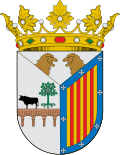
 Santiagova · CC BY-SA 3.0 es
Provincial capital
Salamanca is a municipality and city in the autonomous community of Castile and León in Spain, and the capital of the Province of Salamanca. Attached to the comarca of Campo Charro, the city lies on the northern half of the Meseta Central, in the western-central part of the Iberian Peninsula, straddling the Tormes river. Its population in 2024 was 144,458, making Salamanca the 46th-largest municipality in Spain. The University of Salamanca, founded in 1218, is one of the oldest in Western Europe, and the Old City of Salamanca is a UNESCO World Heritage Site, which every year attracts a significant number of students and cultural tourists.
The Iron Age hilltop site of Cerro de San Vicente on the right bank of the Tormes is considered the first human settlement in the current city. By the 3rd century BC, urban settlement in the nearby Teso de las Catedrales had consolidated under the influence of the Vaccaei and Vettones, regional Celtic tribes. Following Roman subjugation, the indigenous oppidum became the Roman civitas of Salmantica. Little is known of the history of the place after the Migration Period. Christian settlement under the Kingdom of León led by Raymond of Burgundy took hold in the 11th century. The University of Salamanca, founded in 1218, gained widespread recognition in the 16th century for the intellectual production of the so-called School of Salamanca. In addition, the city has also recently developed as a centre for Spanish-language learning.
The Old City of Salamanca is a World Heritage Site, featuring notable examples of plateresque architecture. The Holy Week in Salamanca enjoys the status of Fiesta of International Tourist Interest.
Text from Wikipedia (CC BY-SA)
Keep exploring
Where to eat
We don't have verified restaurants here yet, but the larder of Castilla y León already says a lot.
See the restaurants on the mapWe haven't verified any table with its owner in Salamanca yet. In the meantime, these are the restaurants mapped in the surrounding area.
Up to 30 km around, according to OpenStreetMap and Overture Maps. No ratings or prices: call before you go.
120 restaurants
120 restaurants
Salamanca · in the village+34 616 839 888View on the mapWebsite
Salamanca · in the village+34 923 262 004View on the mapWebsite
Salamanca · in the village+34 923 708 261View on the mapWebsite
Accessible
Salamanca · in the village+34 923 268 322View on the mapWebsite
TerraceAccessible
Salamanca · in the village+34 923 057 715View on the mapWebsite
Salamanca · in the village+34 923 60 72 47View on the map
Terrace
Salamanca · in the village+34 661 633 218View on the map
Salamanca · in the village+34 923 219 018View on the map
Salamanca · in the village+34 923 271 700View on the mapWebsite
Data from OpenStreetMap (ODbL) and Overture Maps (CDLA-Permissive-2.0): what has been mapped with its name. If your restaurant is missing or you want to manage it, sign up as a professional.
The 30 closest to the centre, out of 366 in the municipality.
Data from Overture Maps (CDLA-Permissive-2.0). No opening hours: call before you go.
What people eat in Castilla y León when they eat well.
Suckling lamb in a wood-fired oven, with salad and local red wine.
Rice and onion, griddled until crisp.
Hard-paste Castilian cured cheese; with candeal bread and a young red.
Ribera, Toro, Bierzo: several serious wine appellations in the region.
Almost every village has its market day and its producers: the cheesemaker, the baker, the vegetable garden next door. Ask at the tourist office or the bar on the square; they'll tell you where to buy straight from the maker.
Salamanca has a weekly market, but we don't know which day.
The 12 closest to the centre, out of 41 in the municipality.
Data from Overture Maps (CDLA-Permissive-2.0). No opening hours: call before you go.

