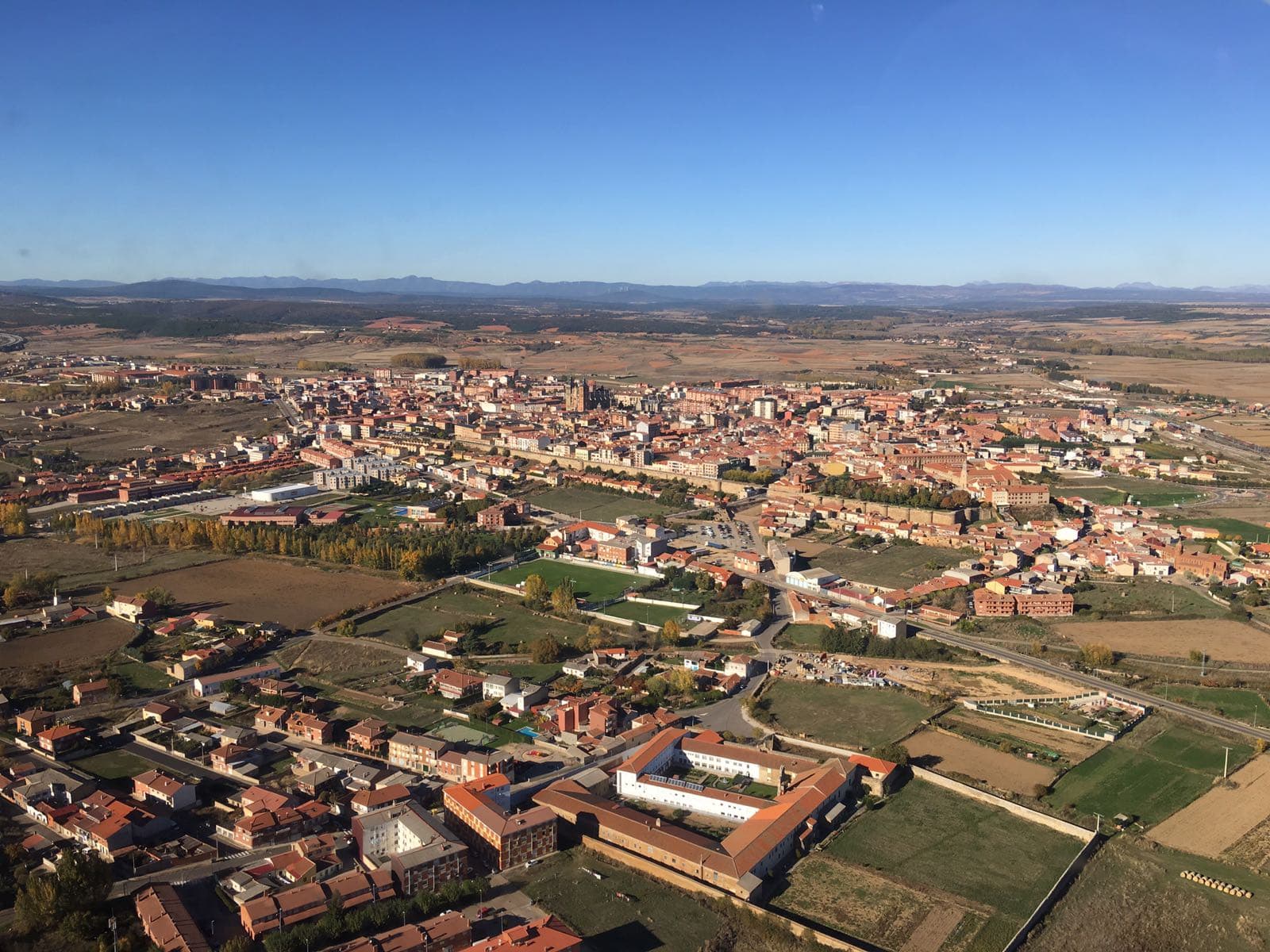
 Rodelar · CC BY-SA 4.0
Town
Astorga (Spanish:, Estorga in the Leonese dialect of Maragatería) is a municipality and city in Spain, located in the Province of León, within the autonomous community of Castile and León. Situated at the transition between the Páramo Leonés and the Montes de León, it serves as a central hub for the regions of Maragatería, La Cepeda, and the Ribera del Órbigo. The city is the seat of one of Spain's oldest and most extensive dioceses, with jurisdiction over half of the province of León and parts of the provinces of Ourense and Zamora. It is also the head of the judicial district number 5 of the province of León.
Founded as a Roman military camp for the Legio X Gemina in the late 1st century BC, it soon transitioned into a civilian settlement known as Asturica Augusta and became the capital of the Conventus Asturum. It developed as a key communication hub in northwestern Iberia and enjoyed prosperity during the first two centuries of the Common Era due to gold mining, earning the description vrbs magnifica from Pliny the Elder. By the mid-3rd century, it likely became an episcopal see, with Basílides as its first bishop. Following the barbarian invasions, it was part of the Kingdom of the Suebi and was captured by Muslim forces under Tariq in 714, though it was reconquered by the Asturian monarchy later that century. In the late 10th century, it faced repeated Muslim assaults led by Almanzor.
From the 11th century, bolstered by the Way of St. James, the city experienced gradual development, with the Church playing a prominent role. In 1465, Henry IV of Castile granted Álvaro Pérez Osorio, Count of Trastámara, Lord of Villalobos, and Castroverde, the title of Marquis of Astorga, transitioning the city from a free status to a feudal condition.
Text from Wikipedia (CC BY-SA)

35 places to stay in Astorga
See places to stay37 restaurants in Astorga
See where to eat5 experiences in Astorga
See experiencesEverything you need for your visit or your day-to-day
Tap a row to see it on the map and how far away it is.
Parks, beaches and places to stay that OpenStreetMap marks as dog-friendly. Many places allow dogs without it being marked: ask when you book.
No data on: street market, pool.
Data from OpenStreetMap (ODbL), extract from October 2026: we count what is mapped within the municipal boundary. "No data" means OpenStreetMap doesn't have it, not that it doesn't exist. Completed with Overture Maps (CDLA-Permissive-2.0): the pharmacies, health centres, petrol stations, banks, cash machines, food shops and schools that OpenStreetMap was missing. Town hall contact details: General Database of Local Entities (Spanish Ministry of Finance); tourist offices: each region's open registry, where it publishes one. Connectivity: Spanish Ministry for Digital Transformation, % of homes covered in June 2025.
Municipal information, services, procedures and grants.
Keep exploring


