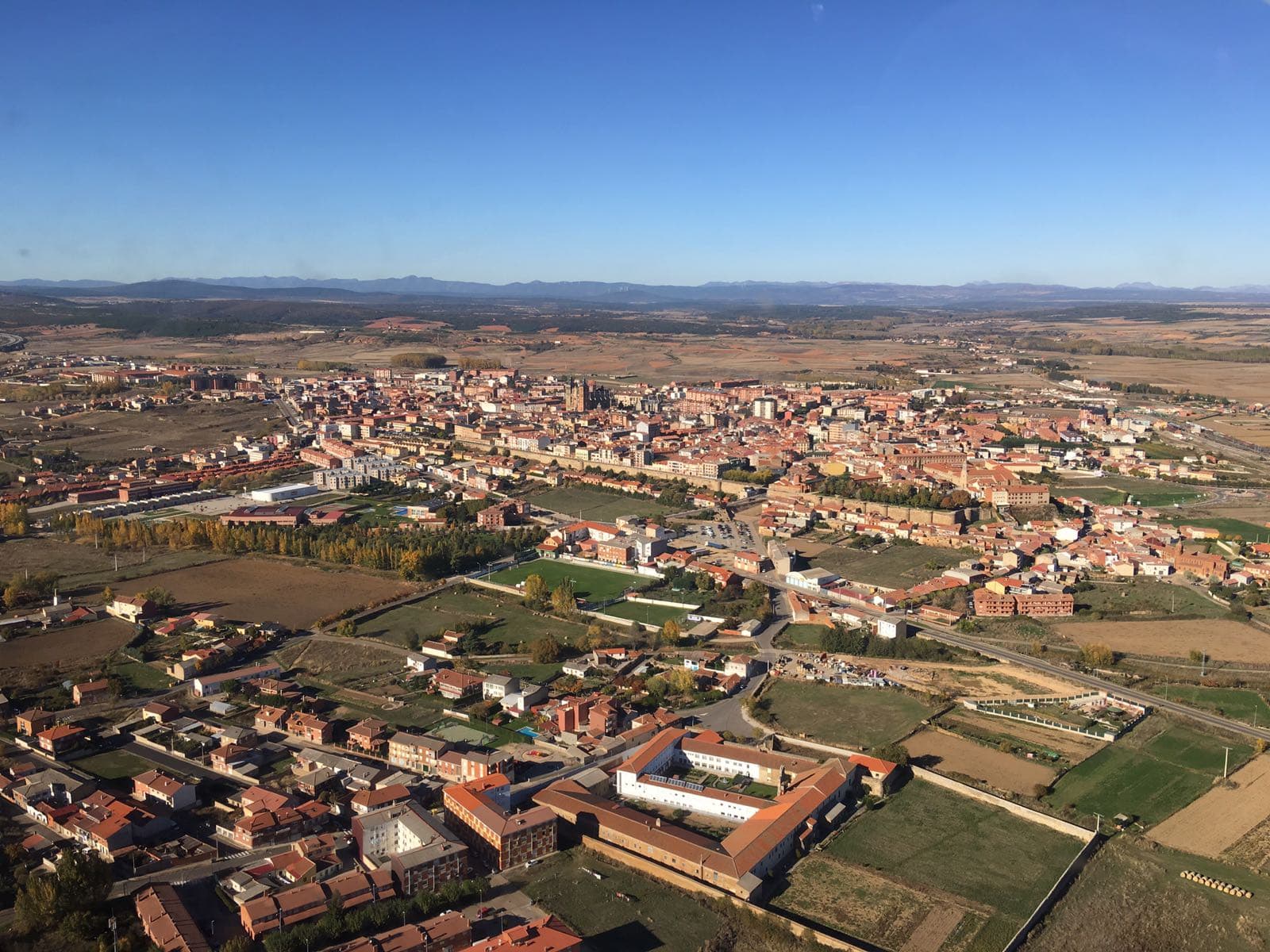
 Rodelar · CC BY-SA 4.0
Town
Astorga (Spanish:, Estorga in the Leonese dialect of Maragatería) is a municipality and city in Spain, located in the Province of León, within the autonomous community of Castile and León. Situated at the transition between the Páramo Leonés and the Montes de León, it serves as a central hub for the regions of Maragatería, La Cepeda, and the Ribera del Órbigo. The city is the seat of one of Spain's oldest and most extensive dioceses, with jurisdiction over half of the province of León and parts of the provinces of Ourense and Zamora. It is also the head of the judicial district number 5 of the province of León.
Founded as a Roman military camp for the Legio X Gemina in the late 1st century BC, it soon transitioned into a civilian settlement known as Asturica Augusta and became the capital of the Conventus Asturum. It developed as a key communication hub in northwestern Iberia and enjoyed prosperity during the first two centuries of the Common Era due to gold mining, earning the description vrbs magnifica from Pliny the Elder. By the mid-3rd century, it likely became an episcopal see, with Basílides as its first bishop. Following the barbarian invasions, it was part of the Kingdom of the Suebi and was captured by Muslim forces under Tariq in 714, though it was reconquered by the Asturian monarchy later that century. In the late 10th century, it faced repeated Muslim assaults led by Almanzor.
From the 11th century, bolstered by the Way of St. James, the city experienced gradual development, with the Church playing a prominent role. In 1465, Henry IV of Castile granted Álvaro Pérez Osorio, Count of Trastámara, Lord of Villalobos, and Castroverde, the title of Marquis of Astorga, transitioning the city from a free status to a feudal condition.
Text from Wikipedia (CC BY-SA)

Keep exploring
16 places to explore Astorga at your own pace. Each number matches its point on the map.

Tell me how much time you have and what you like, and I'll put the places in Astorga in order so you don't go back and forth.
Tap “+ Add to my route” on the places you want to see. We'll split what you can do on foot from what's better by car.
La catedral de Santa María, es la sede episcopal de la diócesis de Astorga, documentada desde el siglo XIII con el título de Apostólica. Se encuentra en la ciudad de Astorga, provincia de León (España).
Catedral católicaBien de interés cultural

El Palacio Episcopal de Astorga es un edificio neogótico situado en la ciudad española de Astorga (León). Fue proyectado por el arquitecto modernista Antoni Gaudí y es una de sus pocas obras realizadas fuera de Cataluña, junto con El Capricho de Comillas, en Cantabria, y la Casa Botines de León.
Palacio episcopalBien de interés cultural

La muralla de Astorga rodea el casco antiguo de la ciudad de Astorga en la provincia de León, en España.
Muralla urbanaBien de interés cultural

La ergástula romana de Astorga es una construcción romana de la antigua ciudad de Asturica Augusta (Astorga). En 1951 fue declarada bien de interés cultural con la categoría de monumento.
MonumentoBien de interés cultural

El Museo de los Caminos está dedicado al Camino de Santiago y se halla en el interior del Palacio Episcopal de Astorga, en la provincia de León (España).
Museo

El Museo del Chocolate es un museo ubicado en la ciudad española de Astorga (León) que conserva la memoria de la industria del chocolate en la ciudad, que llegó a albergar más de medio centenar de fábricas.
Museo

El Museo Romano es un museo ubicado en Astorga, España. Tiene su sede en la llamada «Ergástula romana» y sus colecciones son el resultado de más de tres décadas de excavaciones e investigación arqueológica llevadas a cabo en la ciudad.
Museo arqueológico

El Santuario de la Virgen de Fátima de la ciudad de Astorga, que antes fue iglesia de San Julián, es un templo edificado a finales del siglo XII, renovado en el siglo XVIII y restaurado en el siglo XX, que aún conserva restos románicos, como la portada de la fachada occidental.
Iglesia de culto católico

Los baños públicos, además de lugares para el aseo y cuidado personal, servían como centro de las relaciones sociales y ocupaban un lugar importante en la organización y difrute del ocio en la Antigua Roma.
Termas romanas

Casa consistorialBien de interés cultural

Conjunto históricoBien de interés cultural

Conjunto históricoBien de interés cultural

Monasterio
Monasterio
Museo
Museo
Monuments from Wikidata; summaries from Wikipedia (CC BY-SA) and photos from Wikimedia Commons, credited to their authors.
5 plans to experience Astorga on the move, not just passing through.
3 activities
2 activities
Places and plans from OpenStreetMap (ODbL): what is mapped within the municipal boundary, by name. If something is missing, it can be added there and will appear here in the next update.
What there really is in the village and around it, with distances. If an activity isn't on this list, we haven't found it nearby.

